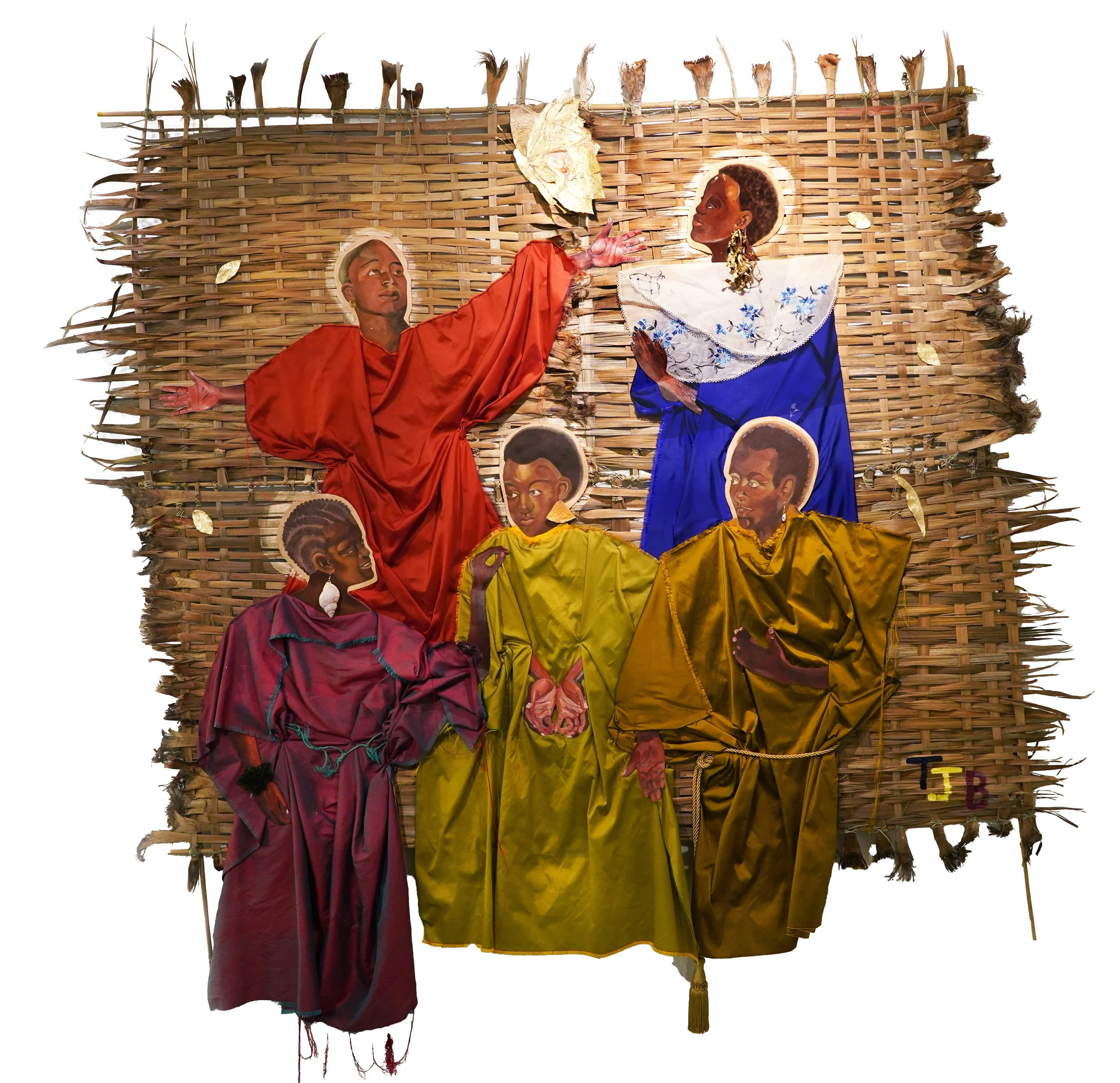
“Fafanto’s children are brought together in an act of freedom. For too long have their faces and existences been trapped under a merciless gaze or faded into the background. They no longer serve their masters, offering them pearls or bowls of fruit, holding maps of the conquered land. Their stories were silently told and here they are given the space to express them.”
‘Fafanto’s Children’ is a work made with the intention to create a new historical narrative for black children painted into aristocratic paintings of the 16th-18th century. These ‘house boys/girls’ were symbolically incorporated into prestigious artworks of the main sitter as means to lift their status and exalt their appearance of power and purity. They stare adoringly at their masters, offering them gifts or even their bodies as an arm rest while the subject in focus stares at the viewer as if to say “look at how I am worshipped.”
This piece is an offering to the individuals featured in it. Their faces have been transcribed from these paintings into a new space where they can proudly step into the foreground.
Paintings include:
Princess Henrietta of Lorraine (1611–1660), Attended by a Page. by Van Dyke : 1634
Countess of Dysart and Duchess of Lauderdale (1626–1698) and an Attendant by Sir Peter Lely : 1651
Louise de Kéroualle, Duchess of Portsmouth with an unknown female attendant by Pierre Mignard : 1682
Sir John Chardin with an unknown male attendant by Unknown artist : 1711
Two Girls with their Black Servant by Joseph Wright: 1769-1770
Fafanto is an African Andinkra symbol symbolizing gentleness, tenderness and fragility. It is also a symbol for change and metamorphosis which encourages us to treat each other with kindness. I chose the title ‘Fafanto’s Children’ for these reasons in this healing. These figures are realizing new, considerate and reflective times in their meeting and celebration.
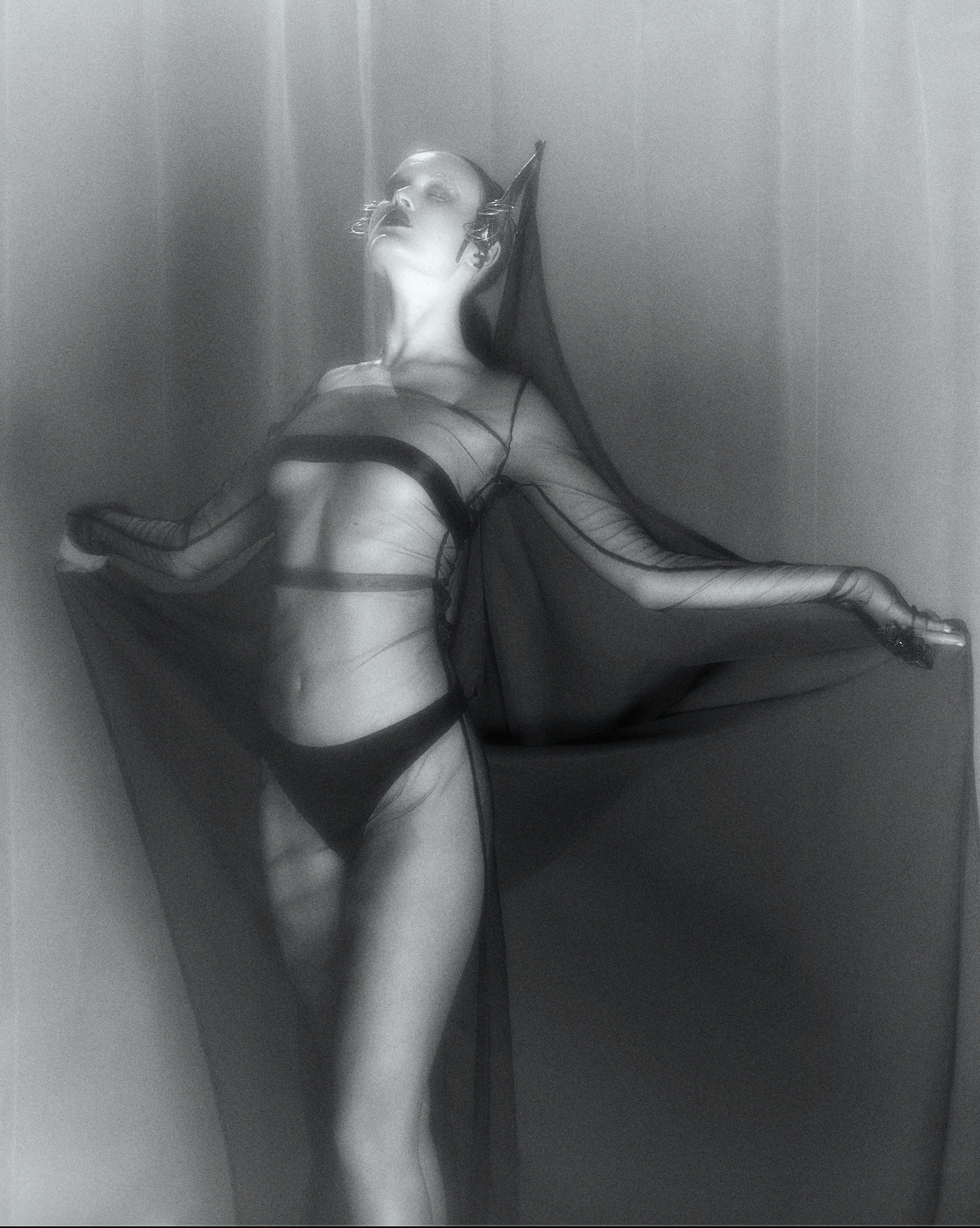
Lace of Infinity by Chloe Heymans
My fingertips of light
And my translucent thighs
Are embedded in the earth
And flying through the night
Are my intrepid thoughts,
Sinking with the veil
Then lifted up by birds
Dancing through air like a team
Carrying the lace of infinity
• Can you share the story behind the name CHILD + THE BANNED? How does it reflect your artistic vision?
I have always been terrified of growing up. I think it’s got something to do with people’s expectations – especially the expectations tied to becoming a woman; it can be so claustrophobic. I struggled with this a lot growing up and during adolescence. Yet somehow, childhood seemed like such a fearless state of being to me. And when I felt the most lost in my life, remembering the fearless energy I’d always had as a child helped me navigate who I was becoming as I grew.
Of course, when a phoniatrics specialist later concluded that my voice was “stuck in a state of puberty”, my artist name came to have a whole other layer to it. I was already gigging with the band as CHILD + THE BANNED; a reference to my obsession with the childlike liberated state of being and to all the banned emotions and demons, which I only in music find the space to express. The moment I found out about the biologically abnormal development of my voice, it was like a prophecy coming true.
• Growing up in Copenhagen and living in London, what role did your environment play in shaping your music and creativity?
I grew up by the sea, north of Copenhagen, in quite a small, protected sphere. I was very ill and taken out of school in early adolescence, which contributed even further to the sense of secludedness that I felt. I was often on my own. I only had a few friends and hardly any kindred spirits. So I spent a lot of time writing songs on my piano. Even when my classmates started partying and chasing romances, I’d be deeply buried in Patti Smith literature; very much inspired by her legendary memoir ‘Just Kids’, I remember having this distinct feeling that there must be another galaxy where my like-minded peers were waiting for me; I just needed to go out into the world and share who I really was. Just like Smith went to New York and became best friends with Robert Mapplethorpe, I would go somewhere and form these special bonds through music, art and creativity. In that sense, London became my version of her 70s New York.
London is in many ways an antidote to Copenhagen. It’s dirtier. And louder. And you are left to your own device if something goes wrong. It’s always diverse, different and creative (and yet, it’s almost impossible to survive here as a creative unless you come from money, or you work and hustle 24/7 –– I belong to the latter of the two, I’m afraid). When I moved, I did not know a soul. But I never felt alone. Everytime I’d go out of the door, I’d be in Disneyland and felt anything could happen, for possibilities were endless. In London, there are always so many people to meet, so many stories to uncover. There is so much space here to be yourself –– and I probably feel embraced for who I am in a way I never quite felt when I was in Denmark.
The sensibilities of both places – of London and of Copenhagen – run through my music. I hear their influences distinctively. The sounds of the sea, of water, of the overgrown garden guarded by a tapestry of wild ivy; the sound of naivety and secludedness and sometimes loneliness; that’s the sentiment of my upbringing. However, the gritty beats, the curiosity, the wildness, thirst and sensuality; those elements speak to the person I became as I blossomed in London. I am as suspended between the two, in my mind and in my music and in my lyrics.
• Your voice has been described as “stuck in a state of puberty.” How has this rare vocal quality shaped your artistic identity and sound?
I have a very high range. My vocal folds are quite long and thin, spaced apart from one another –– not fleshy and sitting close together, as most often is the case for girls in teenage years and above. I believe I’ve expanded my lower range recently, too, though. It helped when I accepted that my voice was just different; that a lot of things normal voices do easily are really hard for me; and vice versa, my voice can do things that are way out of reach for other vocalists. Somehow, accepting your voice as it is, goes hand in hand with truly knowing yourself as an artist: You can only sing with your own voice, there’s no other way to be true. It’s definitely a challenge during those years when you just want to sound like everybody else. But, at some point, you realise being different is the best gift serendipity could ever have granted you.
• Your music has been described as “little reveries unveiling your dramatic perception of a hazy world.” Can you expand on what this means to you?
I am a super emotional and sensitive and, arguably, dramatic person. I only have big emotions. It’s always been like that. The world is confusing to me but in my music, I get to somehow make order of the chaos – even if that order is in fact a crazy mess, at least the process gives me clarity and enables me to process what is happening around me and inside me. And subsequently, I throw my curiosity upon something new.
• CHILD + THE BANNED has performed at an incredible array of venues, from fashion shows to renowned museums. What’s been the most memorable performance so far, and why?
Every performance gives you something different. A new audience. A new energy. A new place. A new challenge. Live performance is so potent and so real. The connection you have with the people in the room is crucial and changes everything. I love the collaborative performances I’ve been so lucky to do, for instance with Michaela (Stark) in Milan or at SHOWstudio, curated by Nick Knight. I love being a part of a team, who –– in the name of creative divinity –– throw all their force into creating a shared moment of beauty, or horror, or both. Every time you connect with a collaborator, it’s as if two different breeds of aliens are meeting one another on a faraway planet, intertwining their tentacles and realising they, for some incredible reason, understand each other’s strange languages. I love that!
The Air in my Lungs
Why do I draw lungs?
During my childhood and adolescence, my life was dominated by fevers, bronchitis, burning mustard-seed poultices, suction cups pulling at the skin on my back, penicillin injections, and the endless monotony of lying in bed.
My bronchi—those delicate tubes that transport air to the alveoli in the lungs, enriching them with oxygen to nourish our brains and muscles—were often infected. They refused to let in the polluted air of the industrial city where I lived.
I was sent to health homes for children with lung diseases...Places where medical treatments felt like medieval torture. Places where cruel punishments were inflicted for things like wetting the bed. I was rebellious—I refused to eat.
At the age of twelve, I underwent surgery. The surgeon removed a lobe of my left lung. Afterward, I was placed in an iron lung, a machine that helped me breathe. With every breath I took, the massive wound on my back reopened, causing me excruciating pain.
Even as an adult, the story of my lungs remained indelibly etched within me. Sometimes, my breathing becomes erratic, and the air seems to refuse to enter my lungs.
This is why I draw lungs in my artwork: they are symbols of air, of life itself.
FIORII
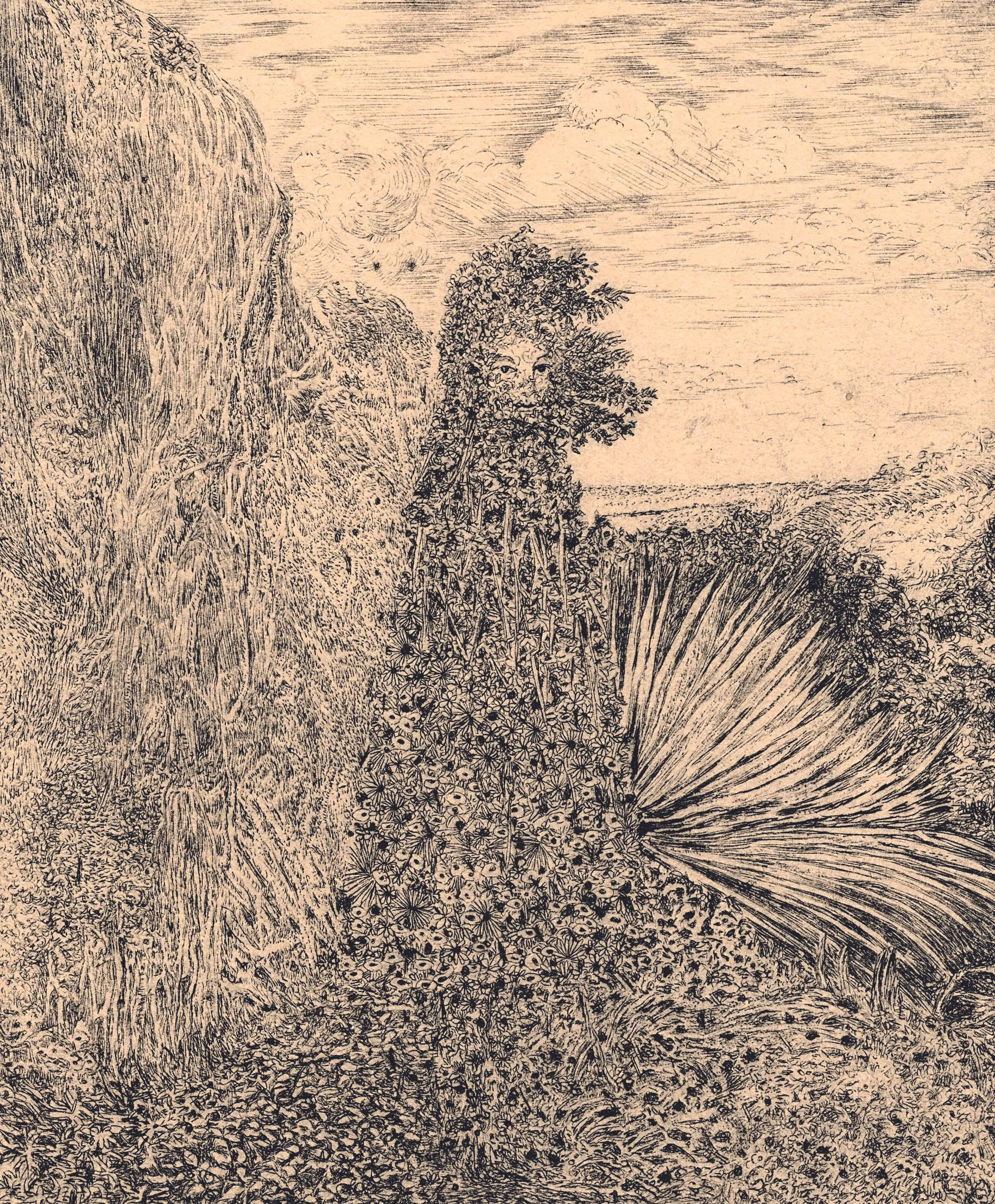
Didier Hamey’s engravings, ranging from small to large formats, depict a captivating bestiary of hybrid, enigmatic figures intertwined with nature and landscapes. These works embody exuberance and the alluring mysteries of the earth and fertility,xq serving as vibrant expressions of natural spontaneity and the joy of life. Widely regarded as one of France’s leading engraving artists, Didier Hamey continues to push the boundaries of this timeless art form.
OU Photoset
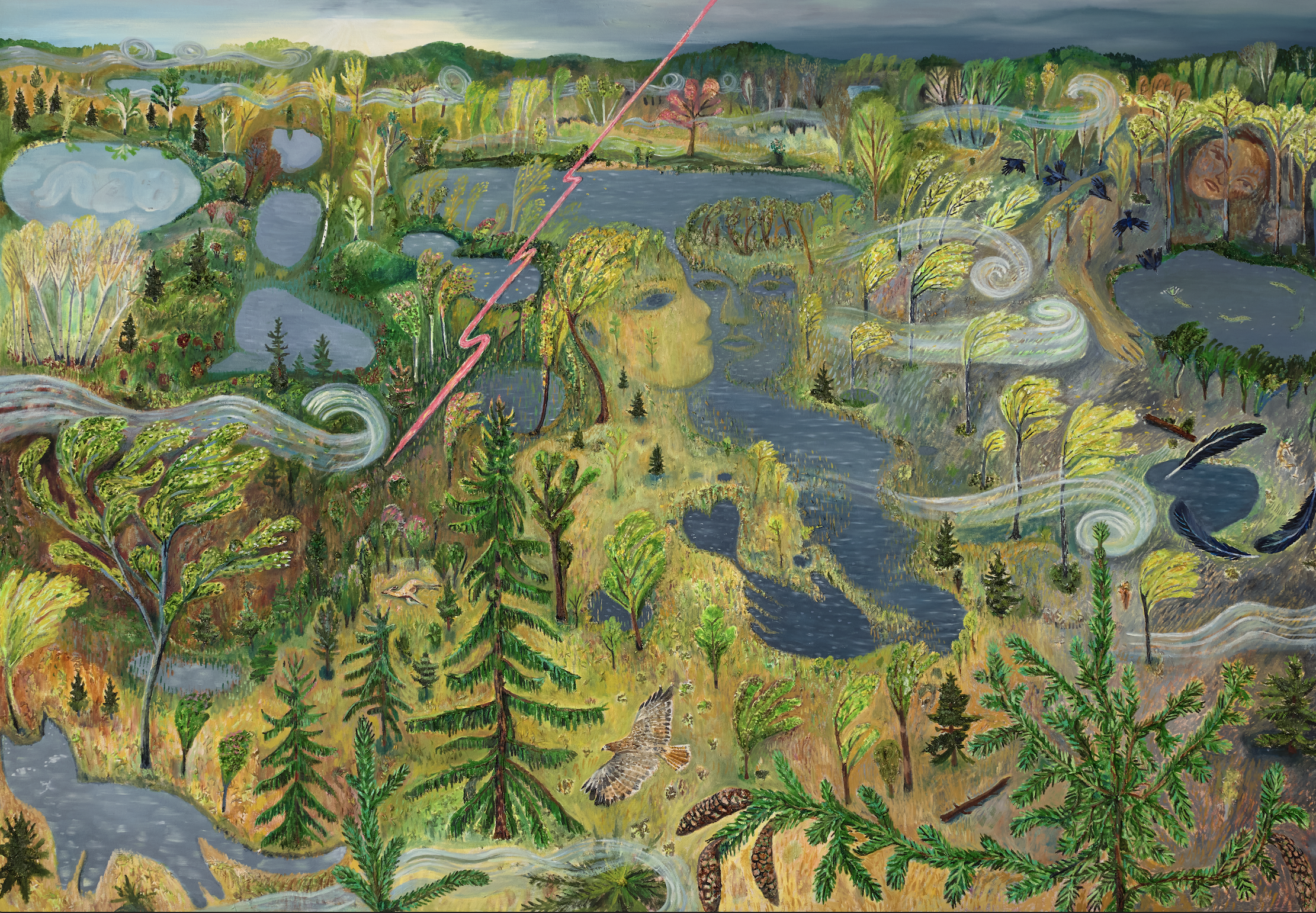
As I select images for this piece, I’m compelled to reconcile with the shifts that have occurred in my work over the past few years. A thread connects these works across various series—perhaps color and form unite them—but fundamentally, my practice has always been driven by a constant questioning and inquiry into ways of seeing and engaging with an image. Painting, as a medium, offers multiple routes to representation.
The theme of this issue is Air, and I believe my work brings a sense of fluidity, both in appearance and ideas. I often return to Miles Davis’s quote, “Play what’s not there,” as a reminder to resist temptation while painting—to avoid stagnation, keep moving, and flow forward in an organic way. Sometimes, I leave a work with a sense of uncertainty, as if it will resolve itself over time without my supervision. In this way, I see painting as something that can be harnessed yet also something that exists beyond the artist’s control. The more I embrace this temporary relationship, the more I’m willing to surrender control and take greater risks. Much of my writing is framed by this way of thinking—positioning myself in relation to something that is constantly shifting, changing, abstracting, morphing. How do I adapt to it? What can I learn from it?
The act of inhaling and exhaling serves as a fitting metaphor for painting—an ebb and flow of visual dialectics, always in motion. I like to think of perception in painting as twofold, experienced in entirely different ways by the artist and the viewer. For the artist, it begins with sourcing and visualizing the image; for the viewer, it is an act of perceiving, interpreting, and re-experiencing. Along this journey, the image can arrive at countless states.
How we see, how we recall what has been told—how an image, a scene, or an object is viewed a second time—is a step toward abstraction. For me, abstraction is a retelling of an image, whether representational or not. Like the retelling of a story, it is never flawless—liberties are taken, pauses emerge where there was once flow, verbosity replaces restraint. The narrative is contained within the retelling, in the small, incidental nuances of that act.”
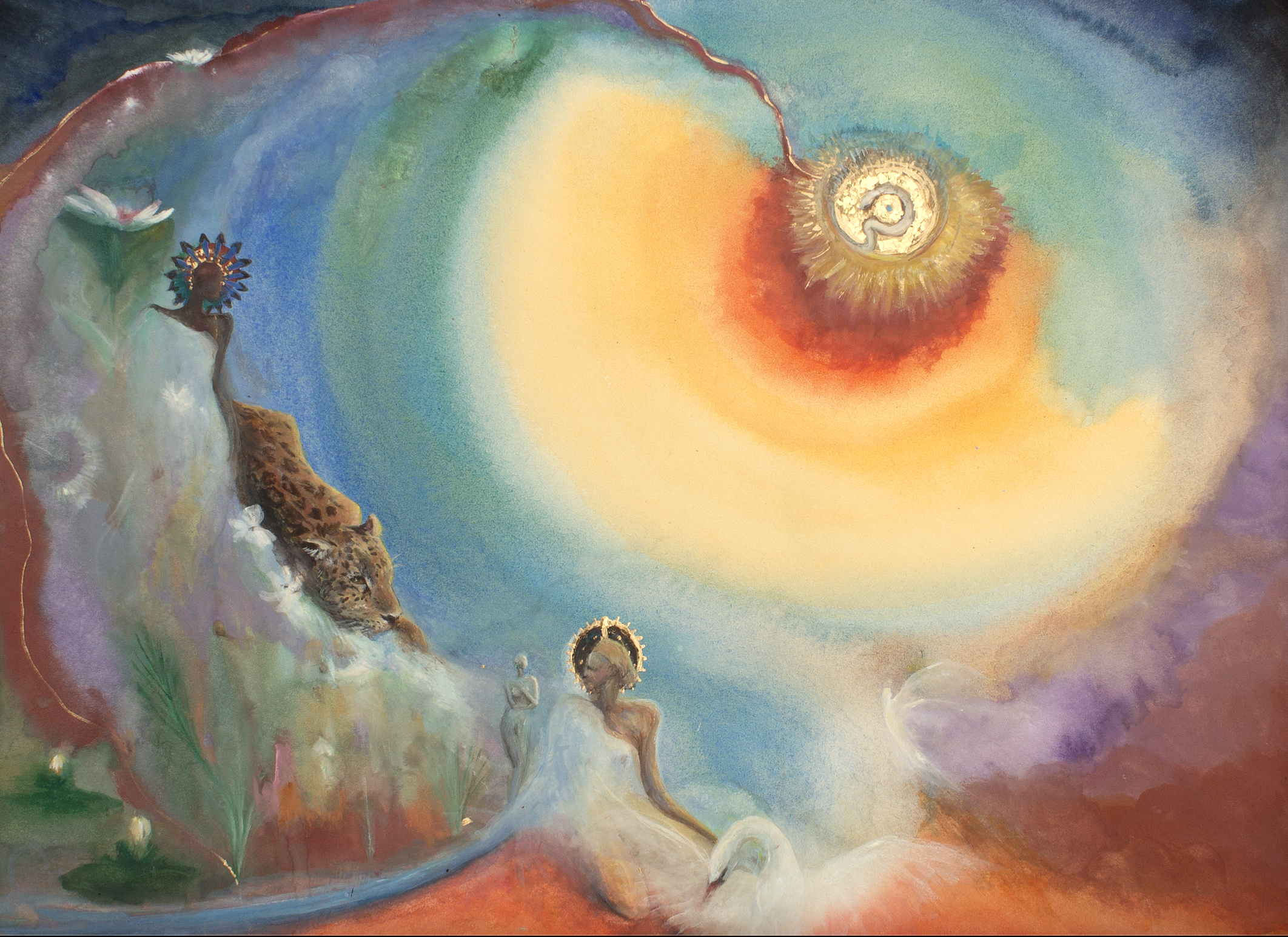
My paintings are meditative and therapeutic channels that bring oneself closer to true nature. They emerge through an animistic worldview of art as self-inquiry and a force for good. In the echos of Carl Jung, I seek to unveil a passage into mystery between a 'tension of opposites’, through archetypes or parts of self, by aligning closely with nature and the elements; diving into the unconscious and emerging with forms that offer a transcendent mirror. The watercolour process too is evocative of subtler realms— elemental, a shapeshifter of forms and timelines, and demanding of presence.
Each painting is a gentle window to confide in, illuminating something of soul life; of consciousness and the working through of personal & collective karmic shadow, of death and rebirth; of form giving way to energy, the mystery of life, whilst revering infinite Spirit in all nature.
That Lethal Cloud
“I explore nuclear explosions as cultural, historical, and iconic symbols. Referencing the scale, beauty, and abhorrent nature of the atom bomb, I delve into the periphery of the subject—the myths, characters, and surrounding evidence. I work across a wide range of media, from vast oil paintings, tapestries, projections, and audioscapes to delicate paintings on glass and ceramics that you could hold in your hand.
Scale is an important aspect of my practice. For instance, in the painting ‘Charlie,’ each square inch of linen represents 4 tons of TNT—which, in turn, is the unit of measurement used to signify the yield of the explosion. These large paintings aim to confront the viewer with an all-consuming landscape. If they inspect them up close, for a moment in time, this is all they can see.
I’m fascinated by the beauty and awe of the landscape—the dust, the glow, the force of the explosion. In this master plan to kill ourselves off, we’ve shown ourselves the end.”
túnels (I,II,III) a man in flames
Documenting an ancestral ritual by Nil Nebot, Jan Nebot and Riaq Miuq in collserola.
GLOBAL ‘SECURITY’
Public protest amplifies the voices of civilians, which are often drowned out amid political debates and dictation. It is a means to express passion and opinion regarding what is important to the people. These photos were taken at a protest against the new French law “Sécurité Globale,” which threatens a €45,000 fine and up to a year in prison for filming or photographing the police with ‘bad intent’, seen by many as a violation of modern democracy.
Living in Paris, I frequently find myself immersed in protests as the French persistently take to the streets year after year to advocate for justice. Although these images convey an almost still atmosphere, the moments and visuals they capture create the ambiance of a battleground, symbolizing the struggle for legal rights. I aimed to document these events to raise awareness of the current atmosphere in one of the world’s most visited capitals.
A portrait triptych of young Gambian men posing against a backdrop of devastating flames. A smoky sky and pastel ambiance prevail, with a cloud of smog lingering on the horizon over West Africa for weeks.
Farmers burn their crop from the last harvest to enrich the soil with fertilizing matter and facilitate the clearing of bushes. This technique also aids in the expansion of new farmlands. It is part of a traditional agricultural cycle, where smoky days constitute a season in themselves, lasting for months. This method has been observed and practiced worldwide for centuries.
Here, a short series comprises environmental portraits of the young men, known as Bush Burners, engaged in these demanding agricultural cycles.
Mainak Bose evokes a dreamlike essence through the artful fusion of double exposures. His creative vision transcends the confines of a single photograph, seeking fulfillment in the harmonious interplay of overlapping images. Each composition becomes a tapestry woven from the threads of his imagination.
“Born of fire? I certainly am. I see it in the stars, in my rage, in my passion, and in my art reflecting and flickering back at me. I no longer deny the feminine in me that desires to sew; to embroider, stitch by stitch, the fabric of the unseen underneath and the topside showy Self. The silver dagger of my needle penetrates, as it is also threaded. This process melts duality. This process unites me with my ancestors. This process reveals myself to me. The stab of the needle, the slender, silvery point directing energy to create form which pleases. No longer a pastime of the ‘incompetent’, the ‘incomplete’ female. Instead, an empowered act of legitimate creation. The divine feminine emerges in unashamedly tough, silken bands and spools of yarn. Yarn to harness, yarn to spin the tale, and to carry on the story.
The fire circle embroidery is inspired by a gathering in the Sussex woodland on the full moon of 6th September 2017. The masculine fire we sat around gazing into, while the feminine, deep well - the reason for choosing the location of the gathering - silently ebbed in the darkness... that is, until someone noticed the full moon shining in its reflection! At this point, we all moved around the well and watched the moon - itself a reflection of the sun. The two can never be apart. I dreamt of this embroidery even as I was sitting in that sacred circle. I imagined the bird’s eye view and felt the natural yin/yang shape which was being formed energetically. It had already created itself before it came to be.
I was wedded to the Universe in a ceremony of divine inclination. This psychological journey with the beyond served as the healing catalyst to reach a state of self-acceptance. Summon the unseen forces, and they will answer. Call upon your ancestors, and they will be with you. The ceremony took place in Panama amidst the presence of cows, spiders, and snakes. The choice to invigorate and empower the Will elevated this performance artwork into something tangible, visceral, and enduring.”
The Kiss by Graham Dean
Creation and Destruction
Creation is inherently tied to destruction—one cannot exist without the other. The act of creating something dismantles what came before, just as destruction clears the way for something new. They are not separate forces but rather two aspects of the same continuous cycle of change.
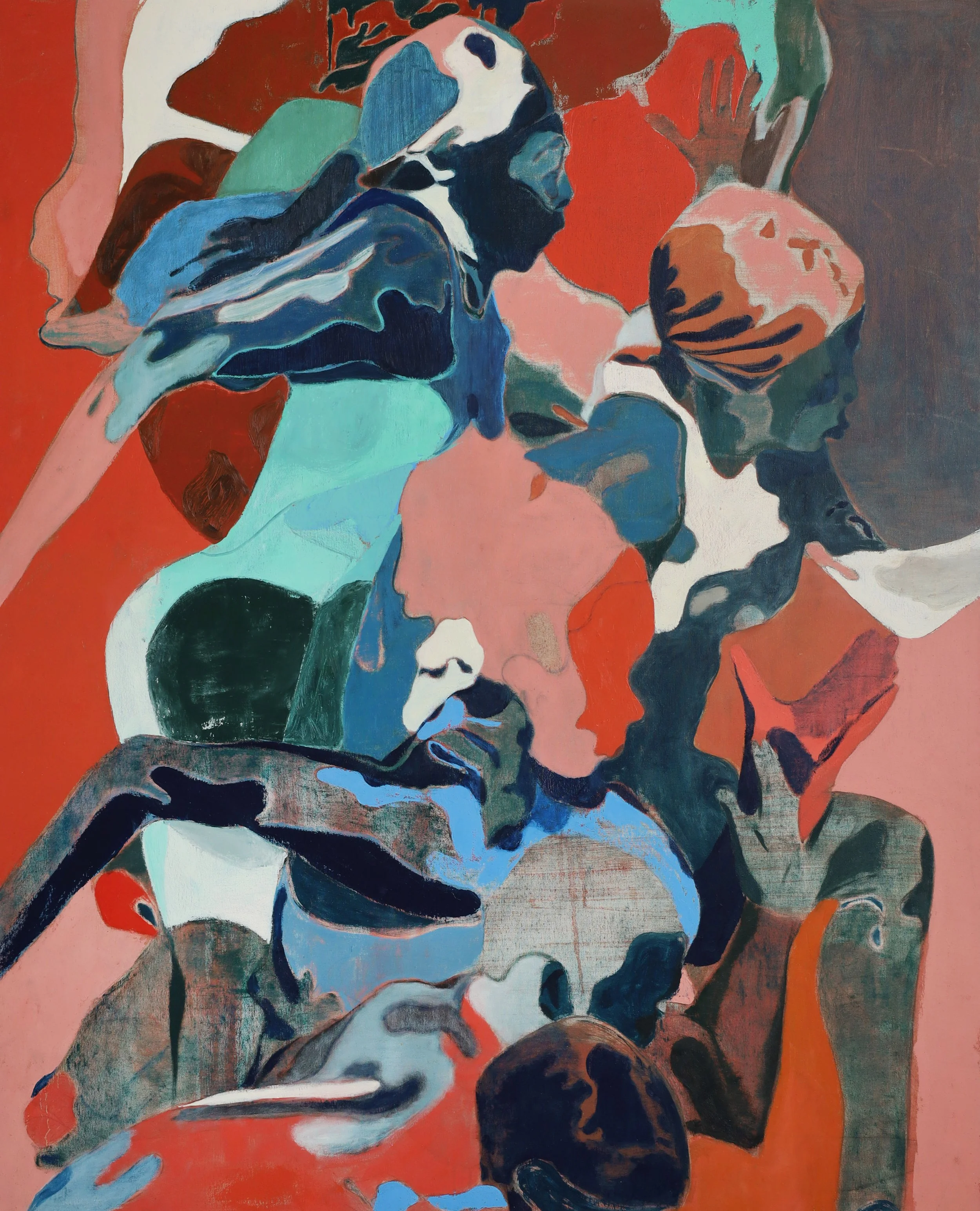
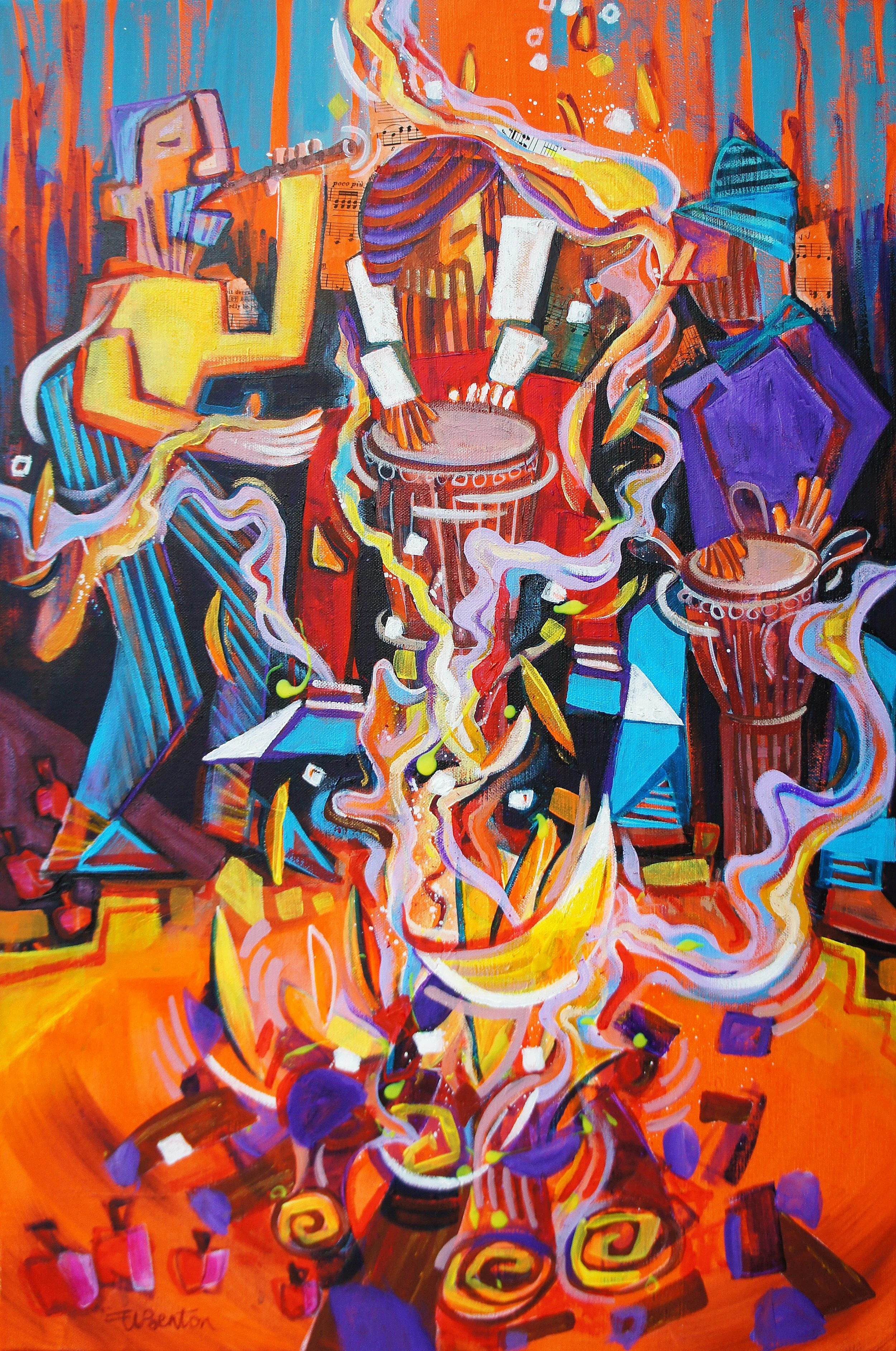
Ellie Benton primarily works in intuitive painting, exploring the emotional, physical, and spiritual dynamics of human relationships and interactions. While her work is predominantly abstract, some pieces incorporate figurative elements inspired by nature, blurring the line between representation and geometric form. A powerful life force runs through all of Ellie’s paintings, and by detaching them from literal interpretation, she invites viewers to discover their own meanings and associations.
Fire is more than a flickering flame; it embodies transformation, passion, and ancient ritual. There is a deep sense of community and connection in sharing sound around a fire—a primal experience that fosters belonging and recalls the simplicity of our ancestors' traditions.
Oleksii is a Ukrainian artist born in the city of Melitopol, Zaporizhia region in 1979. He graduated from the National Academy of Fine Arts and Architecture in Kyiv, specializing in art history, and became the organizer of the project “CultOffice”, aimed at popularizing young Ukrainian artists in the business environment. Later he completed his studies at the International Association of Art Therapists of Ukraine. Based on art therapy techniques “karakuli”, he developed his own visual language for working in graphic media. He is the author of several graphic series united in one cycle called “Premonition”, dedicated to Russia’s hybrid war against Ukraine. He collaborated as an illustrator on political and social themes with the media resource “Bily-Vily”, covering issues of corruption, diplomacy, and the military. Since the beginning of Russia’s full-scale invasion of Ukraine, he has been working on a series of posters called “Red Line”. The first work of the series was a story about Crimea. The process of the poster creation was interrupted by rocket shelling of Kyiv and other cities in Ukraine. Since the spring of 2022, works from this series have become part of various anti-war projects involving Ukrainian artists, both in Ukraine and in many cities in Europe and the United States.
Some works from this series have sparked significant feedback and resonance and have contributed to spreading information about Russia’s aggression against Ukraine. The artwork “Loss” was involved in the diplomatic mission of the President of Ukraine during a visit to the head of the Catholic Church, Pope Francis, in the Vatican. The most horrific consequences of Russian aggression are the deaths of Ukrainian children, the killing of the future, inflicting severe psychological trauma, abductions, and violence:
“All these messages I managed to formulate in one simple and understandable image of the artwork - “Loss”. Of course, the meeting of the President of Ukraine with the head of the Catholic Church caused considerable “burning” in Russia, and the work “Loss,” at that time, became an important tool for understanding what the modern civilized world is facing. This act confirms and distinguishes the uniqueness of Ukrainian society, which since the restoration of Ukraine’s independence has actively engaged art as a resistance element against injustice. “The idea of creating the Red Line poster series arose on the eve of Russia’s large-scale invasion, and I had already begun work on it. The main artistic tool in creating the poster series is a ballpoint pen, which allows complex plots to be realized in a concise manner, enriching the work with volume and depth of expression. Understanding that in the first weeks of the invasion, Ukrainians have the same mixture of feelings and experiences helped to find certain components for clear artistic expression. The house - as a border, the body - as an individuality, are the main characters of my works. The goal of the work was to show not the weakness and helplessness of Ukrainians against the Moscow onslaught, but the anger and unbearable desire for resistance and life. Orienting towards the European viewer, I counted on evoking empathy and sharp emotional sympathy for Ukrainians who resist on the front lines, in occupation, and in the rear. Relying on the empathy of Europeans is considered absolutely appropriate, given the forced and mass exodus of Ukrainian women and children to EU countries. Confirmation of this was and remains the personal story of my children and wife, who managed to leave in the first days and were accepted in one of the EU countries.”
Warriors, fighting with meditative eyes, igniting dignified sincerity and fierce determinate strength in their stillness. Faces, gently peering out of Intimate Spaces, conveying a deep sense of tranquillity. Dreamers’ gazes that have turned inward, reconnecting to the rich treasures and creativity of their inner worlds. Mother Earth is breathing calmly, whilst our humanity trembles on the loosening clutches of our actions and mistakes.
Monica’s world of MMXX, created before the onset of the pandemic, dramatically anticipates a fragment of our current realities ruptured by Covid-19. Yet, what Monica’s delicately moulded and elegantly adorned figures of clay exude, is a profound sense of serenity and introspection. Within the midst of this despair, we are offered a chance to embrace silence, accepting the privilege of slowing down our paces. We have been given time to reflect, and feel grateful for simplicity.
Human beings will resurface from this adversity with vigour, weaving a future that radiates a newfound unity: Individuals living in respectful coexistence, recognising that there is no shame in revealing one’s vulnerability.
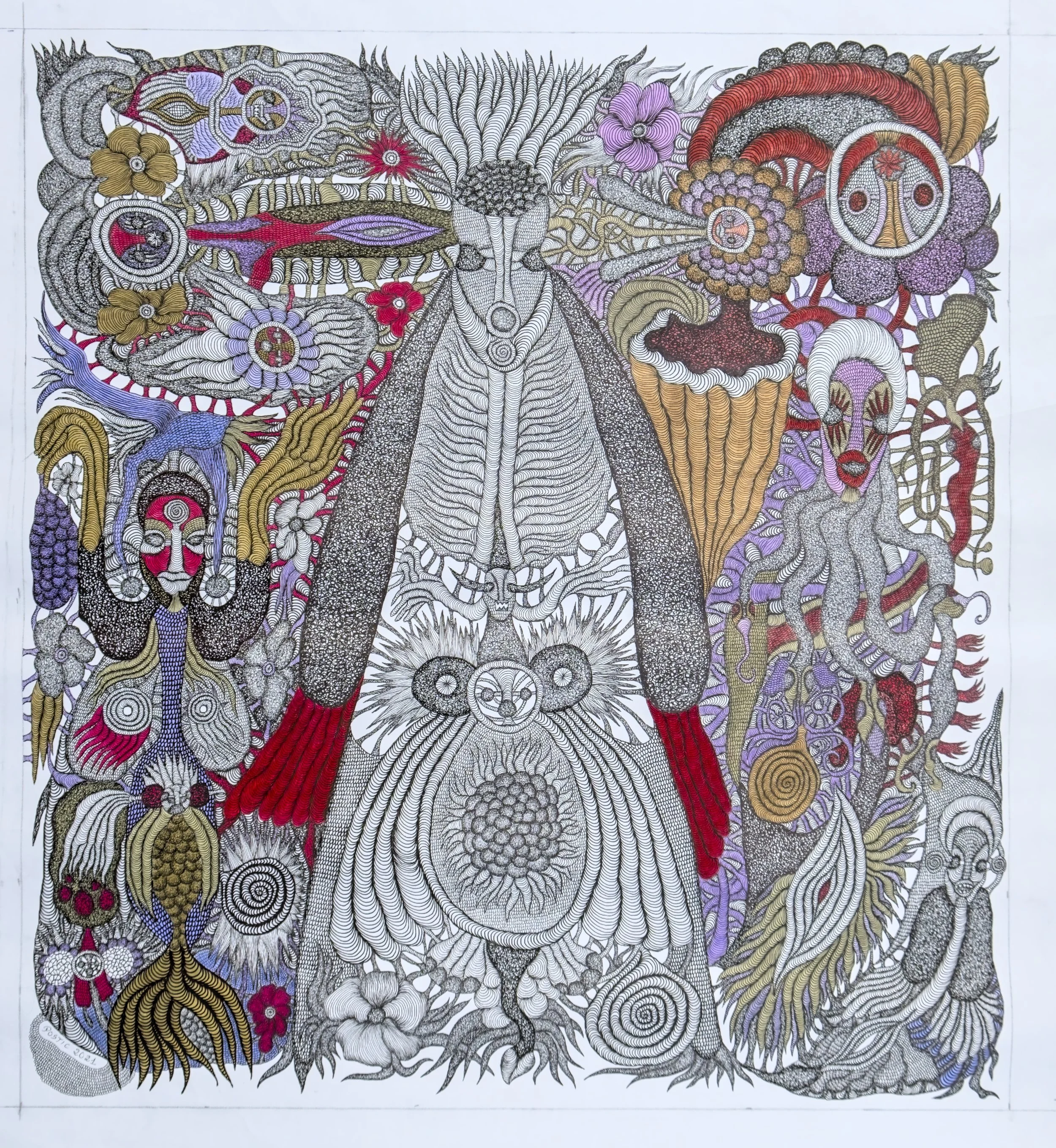
At the core of my creative process lies a concern for nature and humanity. Using stylized, patterned, and brightly colored human figures deliberately ambiguous in their appearance, I aim to delve into the detrimental impact of humanity on our endangered Earth, which I perceive to be accelerating at this juncture.
My style is influenced by the radical opposition in art, and the notion that culturally shared images are crucial to our understanding of environmental, cultural, and social interactions. I am fascinated by patterns and details as a means to captivate the viewer, aiming to underscore the often disregarded infinite intricacies of our surroundings.
/ / @witchtremor
11/11/18
how i learned [to love] the algorithm
Jarrett is an experimental multimedia artist who employs techniques in analogue film photography and typewriting to evoke surrealist imagery. He is passionate about pushing the boundaries of mediums through abstract fiction, while also commenting on poignant sociological and political issues within a contemporary Canadian landscape.
The collected works are part of an ongoing project that investigates eco-death and the Anthropocene through a toxic post-human narrative. The project invokes surrealist imagery, both written and photographic, to explore themes of climate catastrophe, automation, mental illness, and our imminent doom.
César’s analogue photographs from the Boris Johnson protests aimed to ‘stop the coup,’ reflecting widespread discontent and opposition to Johnson’s leadership and Brexit strategy. They serve as a poignant reminder of the cyclical nature of political upheavals. In these images, the echoes of history resonate as they parallel the events of 409 AD when Britain slipped from the control of the Roman Empire, drawing an ironic connection between the modern-day struggle for political autonomy and the historical quest for independence.
Historical evidence suggests that late Roman Britain faced similar challenges to personal and group identities as those being stirred by the current Brexit debate. It is plausible that individuals who now align themselves as Leavers and Remainers would have engaged in fervent debates over issues like foreign immigration and the benefits of remaining within the Roman Empire had they lived in the 5th century. As we reflect on this historical parallel, it is crucial to consider the potential repercussions. We must hope that the more drastic transformations experienced in the 5th century, such as the decline of urban life and the collapse of a monetary economy, do not manifest as their 21st-century equivalents.
Under the Sea
Lauren Drescher is a New York-born artist who currently resides between the French Pyrenees, London and New Zealand. These works are from her Bêtes Humaines series which follows the theme of sentience and our often tenuous connection with nature. Lauren is a full time artist, former midwife, gardener, sea swimmer, lover of the mountains and nature, and dedicated vegan, and her included works are rendered in drypoint, watercolor and pencil on antique English Ledger paper.
We are inseparable from Nature.
@lauren.drescher //
Riaq Miuq (born in Sant Just Desvern, Barcelona, 1994) is a visual artist whose work is based on a fascination with the natural world, spirituality and its contrast with industrial reality.
He studied Applied Mural Arts and Organic Agriculture. The contrast of these doctrines gave him the necessary tools and knowledge to explore his ideals in a plastic way. His work has been shown in Barcelona, Tanger and in GKo Gallery, Tolosa, Basque Country.
Riaq looks for simple techniques using materials available in surroundings, such as collected vegetal fibres and mineral pigments, and industrial materials like garbage, paint, ink or bleach. He is currently part of a group called Neo-Rupestres that works and researches with natural materials, collected from the environment.
His last project is called OMGRA. The shadows under the stars. Omgra is a vivant project that is still growing. It focuses on the creation of four entities representing the four natural elements.
Using the masks as the physical body, the analog photographs provide them with movement, and the drawings give a symbolic explanation.
Every mask correspond to one part of the natural and agrarian cycle. The four together are protected by the force of the OMGRA constellation.
•Harvest (Fire): seed, fructification, reproduction. Red colour.
•Soil (Earth): root, decomposition, mineralization. Black colour.
•Rain (Water): leaf and stem, hydration, two faces: storm-drought. Blue colour.
•Light (air): flower, oxygen, subtlety. White colour.
The idea that this project pursues is -through ritual and symbolic experimentation- to build bridges between the industrial world and the natural or ancestral world. Another purpose is the ambient and social complaint of the degradation of the landscape by our industrial society. Specifically in the mediterranean areas ‘Baix Llobragat’, ‘Collserola’, and ‘Montserrat’. All of them places that served as inspiration and where the different materials used come from.
In the dark forest soil, between leaves, branches and the humus full of tiny life forms, we can find objects such as rusty bottle caps and nails, shotgun cartridges, old plastic ropes... The harvest of these forgotten human traces and other natural materials (vegetable fibres, pumpkins, wood, pigments ...) is a very important part of the process, since these materials are part of two communicating worlds. In this way masks, dresses, mobile pendants and the OMGRA temple were built.